NHL teams handing out no-trade and no-move clauses in contracts is a powerful bargaining chip for teams to attract top talent and said top talent being able to exercise control over their future. However, teams have recently shown they are willing to get “creative” (or maybe manipulative) to put pressure on players or otherwise facilitate moves that such players otherwise would say no to.
Last year we saw an interesting situation with Barclay Goodrow and the New York Rangers (discussed below). And now, we have seen it happen with Dougie Hamilton and the New Jersey Devils as Jeff Marek and Greg Wyshynski discussed on The Sheet on January 12, 2026. They raised a good point that the NHL and NHLPA may need to discuss some NHL no-trade clause questions in the CBA. One question worth exploring, however, is if teams could push too far in these circumstances that lead to CBA issues as it currently stands?
The Sheet with @JeffMarek – January 12, 2026
— The Sheet with Jeff Marek (@thesheethockey) January 13, 2026
🏒 MvsW with @wyshynski
🏒 Wyshynski Responds to Mendes
🏒 Senators, Reimer, and more
🏒 Dougie Hamilton #NJDevils
🏒 @ambrose_13 Joins
🏒 Preparing for Milan
🏒 USA vs CAN Rivalry
🏒 Heated Rivalry
📺 https://t.co/JreYbUXRqI pic.twitter.com/7a3TPXuCQ7
What an NHL No-Trade Clause Is
At a high level, an NHL no-trade clause is basically what it sounds like. It is a clause in an NHL standard player’s contract (SPC) that says the team can’t trade him without his consent. A modified no-trade clause says that the team may only trade the player to certain teams or may not trade him to certain teams, with such teams listed before a certain deadline outlined in the SPC. This is different from a no-move clause which not only prevents the team from trading the player without his consent, but also from buying him out, waiving him, or assigning him to the AHL (or moving him in any fashion) without his consent.
It is important for the player’s agent to make sure any modified no-trade clauses clearly identifies the list of teams in question and that it is respected when a proposed trade is presented. In addition, if a player waives a no-trade clause, the no-trade clause remains in his contract while with his new team. Players must be either 27 years old OR have played at least seven seasons before they are able to receive no-trade or no-move clauses.
It is also very important for teams to be mindful of no-trade clauses in contracts. Especially when they trade a player with that clause. In 2022, the NHL punished the Ottawa Senators after they traded Evgeni Dadonov to the Vegas Golden Knights in 2021. At the trade deadline of 2022, the Golden Knights attempted to trade Dadonov to the Anaheim Ducks. However, Ottawa never notified Vegas that Dadonov had a ten team no-trade list that included Anaheim. The NHL voided the deal and forced Ottawa to forfeit a first round draft pick.
Check out our article on no-move and no-trade clauses here.
Barclay Goodrow and Dougie Hamilton
In the last two seasons, we have seen NHL teams seemingly try to work around no-trade clauses in different but potentially problematic manners.
The Rangers Waive Goodrow
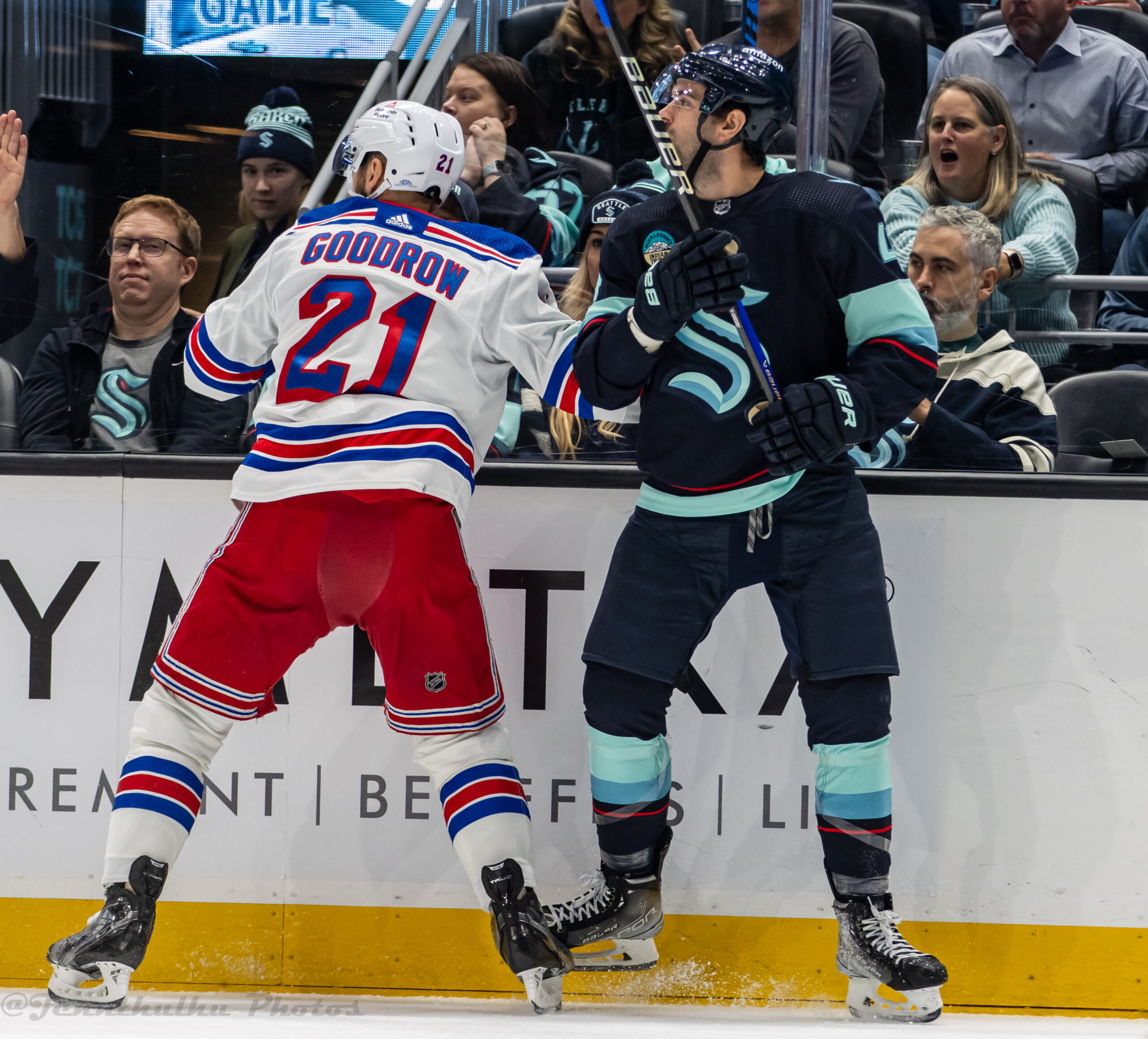
The first came during the 2024 offseason when the New York Rangers attempted to move Barclay Goodrow. In 2021, the Rangers signed Goodrow to a six-year contract with an AAV of $3.64 million. This was after trading a seventh-round draft pick to acquire him from the Tampa Bay Lightning. A bottom-six, physical forward who had just helped the Lightning win back-to-back Stanley Cups, the Rangers saw Goodrow as an important playoff piece. They also gave him a modified no-trade clause allowing him to list 15 teams they could not trade him to.
Then in 2024, with the salary cap remaining fairly stagnant, the Rangers saw Goodrow’s salary as one that needed shedding. With limited teams willing to take on that cap hit for a depth player with limited production, the Rangers decided to waive him. To the Ranger’s benefit, the San Jose Sharks stepped in and claimed Goodrow.
A Possible Back-Door Deal
But here is where it gets interesting. Reports indicated that Goodrow likely had the Sharks on his 15 team no-trade list. This made it impossible for the Rangers to facilitate a trade to one of the few likely suitors. The were additional reports that Rangers general manager Chris Drury and Sharks general manager Mike Grier may have had a behind the scenes agreement that the Sharks would claim Goodrow if placed on waivers.
These reports were nothing more than guesses and were never fully substantiated. So we can’t say for sure this was the case. Nor were there any follow up deals between the Sharks and Rangers that may cause additional suspension. But given Goodrow’s player profile at the time mixed with his cap hit, you probably wouldn’t be looking at more than a late round draft pick traded for him. The cap relief was the goal for the Rangers. There are historical ties between Grier and Drury (they played college hockey together at BU) and it’s no secret the NHL operates like a close group club. But again, we can’t make false accusations without additional evidence.
Regardless, Goodrow was reportedly upset with how the Rangers handled it but has since seemed to have settled into a mentor role on a young and promising Sharks team. But if the back-door deal was in fact true, would there be an issue?
The Devils Sit Hamilton
The second potential issue involved an NHL no-trade clause that happened during the 2025-26 season. The New Jersey Devils had signed Dougie Hamilton to a seven-year contract with an AAV of $9 million during the summer of 2021. Included with that contract was a no-move clause until the 2025-26 season at which point it changed to a modified no-trade clause. The modified no-trade clause included a ten-team trade list Hamilton could submit.
When Hamilton signed that deal, he was considered a very good offensive defenseman after playing the previous few seasons with the Carolina Hurricanes. One of the biggest splashes of that free agency period. But as time went on, his contributions were not at the level the Devils had hoped for and in many ways he became the odd man out with his contract. The Devils reportedly were attempting to move Hamilton but he blocked those attempts by exercising his no-trade clause. Which was 100% his right to do. Reports indicated that there was in fact a deal to send him to the Sharks during the summer of 2025 that he blocked.
This hold up seemed to really come to a head when the Vancouver Canucks moved elite defenseman Quinn Hughes to the Minnesota Wild. The Devils were seen as the favorites to land the high scoring defenseman considering his brothers Jack and Luke both played for New Jersey. But with the Wild ponying up at the right time and the Devils seemingly unable to clear out cap space, Hughes found his way to the state of hockey. Although Devils general manager Tom Fitzgerald refuted that no-trade clauses prevented the Hughes deal, the timing of everything seemed interesting. But it could have been just noise.
Hamilton Scratched
However, to make things more interesting, the Devils scratched Hamilton in their game on January 11, 2026 against the Winnipeg Jets. Head coach Sheldon Keefe and Fitzgerald both claimed it was a coaching decision given that Simon Nemec and Jonthan Kovacevic were both returning to the lineup from injuries. But Hamilton’s agent claimed that it was not performance related but instead a business decision that seemed suspect given the timing. Nothing more was made of it and Hamilton returned to the lineup their next game.
It did raise some interesting questions that led to the discussion between Marek and Wyshynski. Was this a calculated move to put pressure on Hamilton to waive his no-trade clause? His agent claims they were working to be flexible to help facilitate a trade. But if this was pressure, should the NHL allow it? Just as a modified NHL no-trade clause is intentionally different than a no-move clause, it also doesn’t mean the player has to play. Just that the team must pay them and cannot trade them with certain parameters. There could be some room for interpretation here though as we will discuss below.
The “No-Circumvention” Rules Under the CBA
The rules in the CBA (and the corresponding Memorandum of Understandings modifying it through 2030) do not provide much more on an NHL no-trade clause or no-move clause than explained above. If a player has a no-move clause, the team can’t move him. If he has a no-trade or modified no-trade clause, the team can’t trade him within the parameters of such clause as modified. Waiving a player is no problem if he doesn’t have a no-movement clause. Sitting a player is no problem with either clause.
So why have these two events raised the question of a potential CBA issue? Article 26 of the NHL CBA addresses the possibility of any actions that “circumvent the terms of the CBA.” This section of the CBA is used sometimes whenever questionable issues arise that are not directly addressed in the CBA itself. Even though the Article gives a non-exhaustive list of specific examples of CBA circumvention, it also simply provides the following:
26.3 Circumventions.
(a) No Club or Club Actor, directly or indirectly, may: (i) enter into any agreements,
promises, undertakings, representations, commitments, inducements, assurances of intent, or understandings of any kind, whether express, implied, oral or written, including without
limitation, any SPC, Qualifying Offer, Offer Sheet or other transaction, or (ii) take or fail to take any action whatsoever, if either (i) or (ii) is intended to or has the effect of defeating or Circumventing the provisions of this Agreement or the intention of the parties as reflected by the provisions of this Agreement, including without limitation, provisions with respect to the financial and other reporting obligations of the Clubs and the League, Team Payroll Range, Player Compensation Cost Redistribution System, the Entry Level System and/or Free Agency….
(f) No Club or Club Actor or Player or Player Actor shall induce or attempt to induce
any other Club or Club Actor or Player or Player Actor or cause any other Club or Club Actor or Player or Player Actor to be induced to engage in any Circumvention that violates this Section 26.3.
Additionally, the NHL teams and NHLPA both have obligations to disclose anything that even gives the reasonable indication of a CBA circumvention.
One of the most famous instances where the NHL used this Article was when the Devils attempted to sign Ilya Kovalchuk to a long, front-loaded contract to reduce his overall cap hit. Even though the length and amount of the deal itself didn’t expressly breach the terms of the CBA, the NHL alleged that it was an attempt to circumvent the terms of the CBA (specifically the Team Payroll Range of Article 11). An arbitrator upheld the NHL’s position and they voided the deal.
Analysis Under Article 26 of the CBA
So when you look at this from the CBA compared to the Goodrow and Hamilton situations, the analysis falls a little differently. For Goodrow, IF there was factual evidence that Drury and Grier made a back-door deal, I believe the NHLPA would have a good case to allege CBA circumvention against both teams. It’s not too hard to see that they essentially made a trade without actually making a trade that directly violated Goodrow’s no-trade protection. As Section 26.3(a) specifically provides, this deal would defeat the provisions of the CBA related to no-trade protection. Without such factual evidence, however, the case is all but moot. But the analysis remains the same and is an interesting circumstance that could have caused a stink in the NHL.
The Hamilton situation may be a tougher case for the player and the NHLPA. Again, if there was some factual evidence that Hamilton was being scratched to pressure him to waive his no-trade protection, there might be a straw for the NHLPA to grab at. But the problem is that teams can scratch players for no reason at all, and therefore don’t actually need to provide a reason. Likewise, without a no-move clause, buyouts and waivers are alternative options. Not saying it is good business to use scratching a player to pressure him to accept a trade, but it seems like a tough hill to die on for the NHLPA as it relates to a CBA violation.
Future Possibilities
The reality of both of these situations is that neither player nor the NHLPA will ever likely challenge them directly. But what is more likely to occur is the NHLPA taking note of teams starting to attempt to work around NHL no-trade and no-move clauses. This then leads to attempted changes to the CBA. While the current form of the CBA is in place until 2030, both sides may agree to amend it before then. And this likely would be in the best interest of both parties.
Pay to Waive Protection
As Marek and Wyshynski discussed, one possibility is for teams to pay players to waive their no-trade and no-move clauses. It’s a bit like buying back paid-time-off. The player would have to agree to it so they still have power. But there would be a clear incentive for them to waive to facilitate a trade. This also gives the team the ability to possibly work their way out of a handcuffed situation. More than anything, it gives a very clear directive as to how to resolve these issues and logjams.
Agreement Always Wins
Would that in itself prevent situations like those mentioned above? Maybe, maybe not. But again, the important thing is to get ahead of this and figure out a solution. We may also see teams being more reluctant to hand out these clauses in contract negotiations in the future.
In the end, teams want some flexibility and relief, and players want some certainty and protection. The only way that many issues get resolved in the CBA are after they actually become issues. For example, the LTIR salary cap loophole only became an issue after many teams utilized it. The solution? An update to the CBA. Everyone benefits from agreement that is mutually beneficial. When things break down and fighting ensues, no one truly wins. This is the nature of collective bargaining. Don’t be surprised to see the NHL and NHLPA discuss this issue in the near future.
Check out our article on the LTIR loophole here.
Article image by: Jenn G, CC BY-SA 2.0 https://creativecommons.org/licenses/by-sa/2.0, via Wikimedia Commons