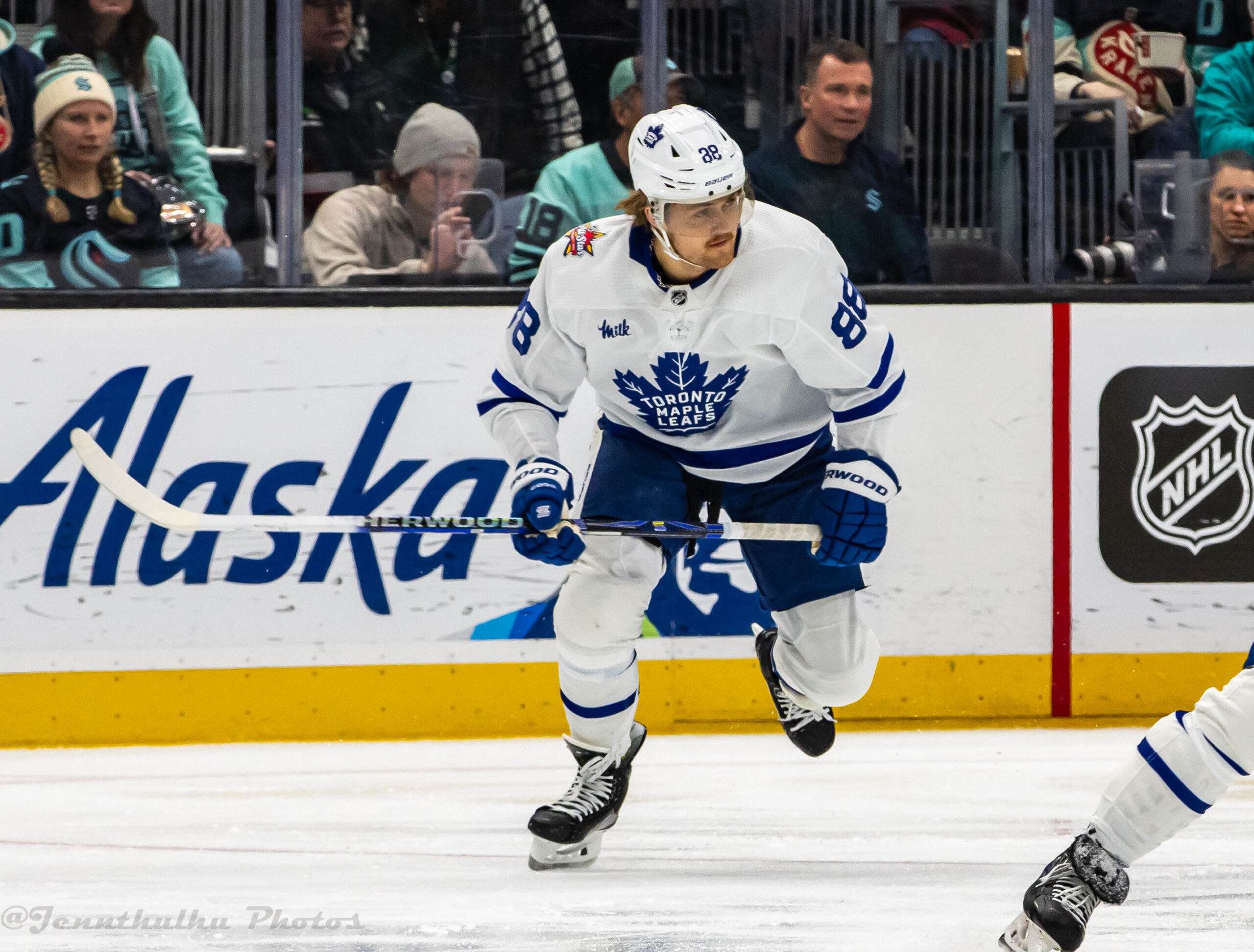
On Sunday January 25, 2026 the Toronto Maple Leafs played a home game against the Colorado Avalanche. The Avalanche dominated the game and left with a 4-1 victory. However, during the game, the camera panned to where the Maple Leafs injured and scratched players were sitting in the crowd. Noticing the camera on them, Maple Leafs injured forward William Nylander looked at the camera and gave it the middle finger.
After apologizing for the incident and expressing that his frustration lead to the gesture, reports indicated that the NHL was looking at potentially punishing the Swedish forward for his actions. Given the severity of many issues the NHL has faced lately and much discourse among fans about how the NHL disciplines questionable on-ice plays leading to injury, this certainly seems like a harmless incident. But this article does not look at whether the NHL SHOULD punish Nylander, but why the NHL COULD punish Nylander.
The NHL is looking at this William Nylander incident, per sources. It's possible the #leafs forward will face punishment for flipping the middle finger at the broadcast camera during today's game.
— Chris Johnston (@reporterchris) January 26, 2026
Nylander has since apologized, calling it a "moment of frustration." pic.twitter.com/rmitPYDyd2
Gary Bettman has Broad Discretion to Punish Nylander
Article 18-A of the NHL’s CBA, as modified by the 2020 and 2025 MOUs, gives the NHL commissioner broad discretion to punish players for off-ice conduct. Specifically, Section 18-A.2 of the CBA provides the following:
18-A.2 Commissioner Authority to Impose Discipline for Off-Ice Conduct.
Whenever the Commissioner determines that a Player has violated a League Rule applicable to Players (other than Playing Rules subjecting the Player to potential Supplementary Discipline for On-Ice Conduct), or has been or is guilty of conduct (whether during or outside the playing season) that is detrimental to or against the welfare of the League or the game of hockey, he may discipline such Player in any or all of the following respects:
(a) by expelling or suspending such Player for a definite or indefinite period;
(b) by cancelling any SPC that such Player has with any Member Club; or
(c) by imposing a fine on the Player not exceeding the maximum permissible fine
under Section 18.7(b).
For an incident like this the only punishment that likely makes any sense is a fine. Section 18.7(b) of the CBA provides the following:
(b) A fine may be in an amount up to fifty percent (50%) of the Player’s Paragraph 1 NHL Salary and Bonuses, but not including Performance Bonuses, divided by the number of days in the Regular Season, but in no event shall it exceed $15,000 for the first fine and $20,000 for any subsequent fine imposed in any rolling twelve (12) month calendar period. Player Salary and Bonuses forfeited due to a fine will be calculated based on a Player’s Averaged Amount.
This Isn’t Criminal Activity
As seen above, the CBA provides pretty wide discretion for the Commissioner to determine if an activity “detrimental to or against the welfare of the League or the game of hockey.” We have seen the NHL exercise this power previously when players commit or allegedly commit criminal or illegal activity. For example, in 2014, Bettman suspended defenseman Slava Voynov of the Los Angeles Kings following his arrest on suspicion of domestic violence. Another example is when the NHL suspended Auston Watson in 2017 for 27 games after he plead no-contest to domestic assault charges. The NHLPA appealed that decision to an independent arbitrator who ultimately reduced his sentence.
In addition, a team can punish a player for violating team rules or a “material breach of contract.” There have been some interesting cases under this umbrella such as Mike Richards and the Los Angelese Kings and Jake Dotchin showing up to the Tampa Bay Lightning’s training camp out of shape. But this seems like just the NHL will punish Nylander. While a material breach is not clearly defined, this likely doesn’t come close to reaching that level.
Check out our article on Jake Dotchin with an explanation of material breaches of NHL contracts here.
So What Was It? League Rule 75
But here Nylander didn’t commit crime. What he did do however, was break a league rule. Rule 75 of the NHL Official Rules provides that any player or non-playing Club personnel are responsible for their conduct at all times and must endeavor to prevent disorderly conduct before, during or after the game, on or off the ice and any place in the rink. That Rule further provides that penalties may be assessed for obscene gestures. More notably, Rule 75.6 provides that game and Club officials must report the incident to the Commissioner for further disciplinary action. This same incident happened in 2011 when Andrew Ference of the Boston Bruins gave the middle finger while playing. The NHL punished him with a fine.
The Rule however makes it pretty clear that 1. this can apply to players that are not playing but are at the rink, and 2. that the Commissioner can further punish the player. “League Rules” in the CBA is defined as “the Constitution and By-Laws, resolutions, rules, and regulations of the NHL (other than this Agreement) and/or any official interpretations of any of them.” So taking all of this together, Bettman’s power to punish Nylander falls under pretty clear language relating to violating league rules.
But even if that didn’t exist, you could likely go back to the broad language found in Section 18-A.2 giving Bettman the power to punish Nylander.
A Slap on the Wrist at Best
Ultimately, Bettman has authority to punish Nylander here. The extent of that punishment though is likely very narrow. A suspension would be a way overreach and any fine should be minimal. The trivial nature of the incident seems to lead to a likely appeal by the NHLPA if there is any hint of excess punishment. Procedurally, Article 18-A lays out that the league must notify the NHLPA immediately if it decides to investigate an incident under this Article. Then, it must notify the NHLPA if it intends to interview the player. The player is entitled to a hearing on the matter and after the NHL makes its decision, the NHLPA may appeal the Commissioner’s decision.
Most likely, Nylander gets a small fine and everyone moves on. There doesn’t seem to be too much to “investigate” and if Bettman goes too hard the NHLPA can appeal. But it does show that the league has broad power to punish even seemingly harmless incidents due to the nature of the language in the CBA and league rules. It also shows how there are clear incidents warranting punishment but that the league also has pretty wide discretion to punish other actions (for better or worse). Of course, much could be made about how the NHL handles other incidents, but that’s a story for another day….
Article image by: Jenn G from Seattle, WA, CC BY-SA 2.0 https://creativecommons.org/licenses/by-sa/2.0, via Wikimedia Commons